


Everything measured.
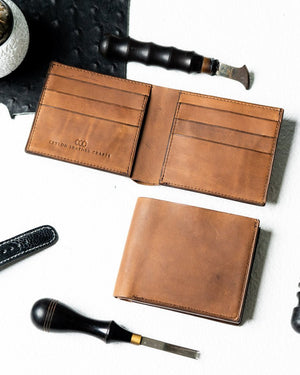
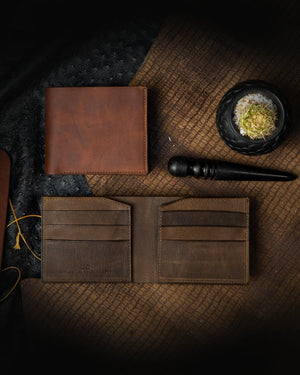
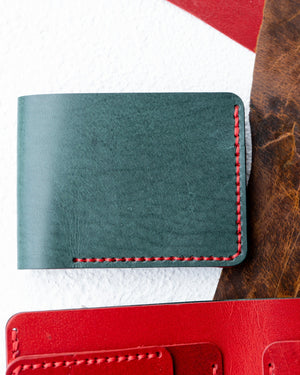
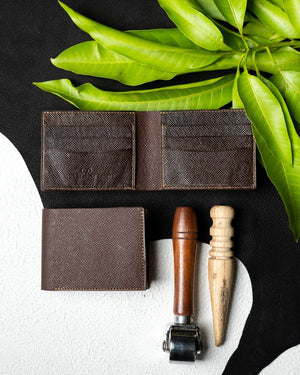
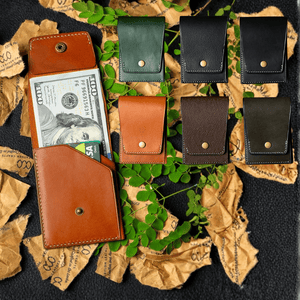
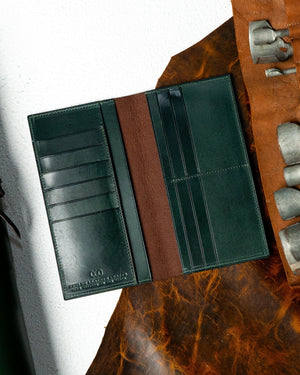
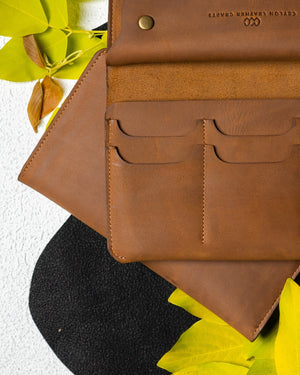
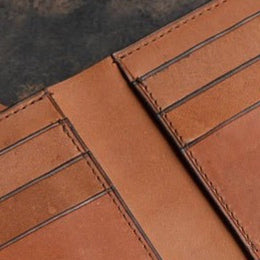
A handmade slim leather card wallet in green buffalo calf, vegetable tanned and made by hand in Sri Lanka. Ten to twelve cards, up to twenty notes, under a centimetre thick.
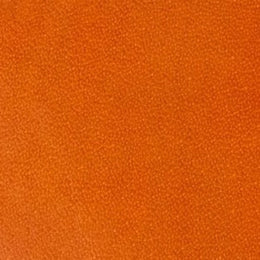
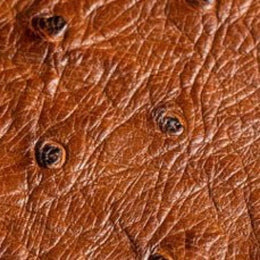
Buffalo calf gives this one its character — a bigger, more open grain than cow, so the deep green never reads as a flat block of colour. It sits darker in the grain and lifts on the surface, which is what stops a strong colour looking synthetic.
It works like a compact bifold but carries like a card holder. That is the whole idea: nothing given up except bulk.
What it holds
- 10 to 12 cards
- 10 to 20 cash notes
- 11 cm (H) × 7.5 cm (W) folded
- Under 1 cm thick
Living with it
Vegetable tanned with nothing sealed over the top, so it will keep deepening with use. Condition twice a year. Repaired for as long as you own it, and the labour is on us.
Straight answers.
When will it reach me?
+
Within Sri Lanka — dispatched within 72 working hours.
Anywhere else — the rate depends on the country, so it is quoted per order. Message +94 77 969 6203 on WhatsApp with the piece and where it is going, and we will send the exact figure before you pay a rupee.
What if the cards don't fit?
+
In the first week the slots are usually tight. That is normal — the leather has to mould to what you carry, and it will.
If it still is not right after that, send it back. We will fix it and send it back to you.
Can you repair it later?
+
Yes — for as long as you own it, and we do not charge for the labour. Not for the first year. For as long as it is yours.
You cover only the materials a repair actually needs, and the shipping both ways.
How do I look after it?
+
Condition it roughly every six months. That is the whole routine — more than that softens the fibres and the piece loses its shape.
Your first three conditionings we do for you. Send it in and cover the shipping; the work is ours. Or do it at home — see leather care.
Why does hand stitching cost more?
+
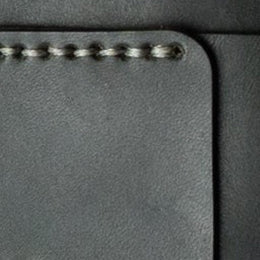
A machine lock-stitch is one thread looping through itself. Cut it anywhere and the seam runs. A saddle stitch is two needles crossing in every hole — cut one thread and it still holds.
It takes far longer by hand, and that time is the whole of the price difference.