
What Is Leather, and Why It Lasts
Leather has been made the same way for thousands of years, and most of what is sold under the name today is not what our grandparents would have recognised. This is what it actually is, and why a well-made leather piece outlives almost everything else you own.
What leather actually is
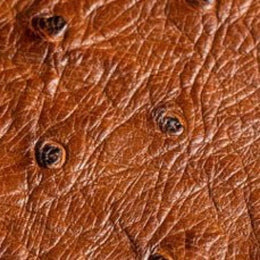
Leather is animal hide that has been tanned — treated so the protein structure stops decaying and becomes stable, flexible and permanent. Cattle mostly, but also calf, goat, buffalo and, occasionally, exotics like ostrich.
Tanning is the whole craft. Vegetable tanning uses tree bark and takes weeks; chrome tanning uses mineral salts and takes about a day. Neither is dishonest, but they produce very different materials, and the one you want depends entirely on whether you would rather your wallet stay as it is or change with you.
The part that decides everything: which layer
A hide has layers, and the layer a wallet is cut from matters more than the tannage, the colour or the brand.
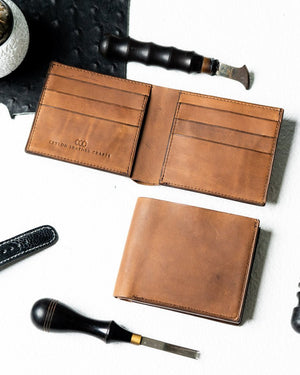
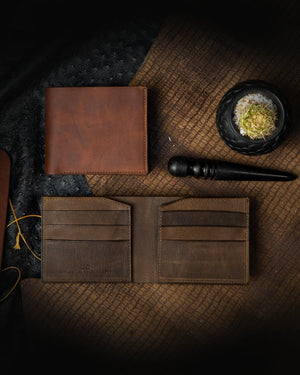
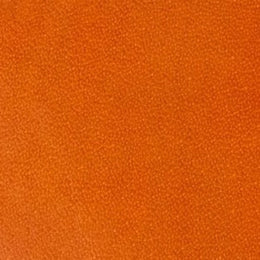
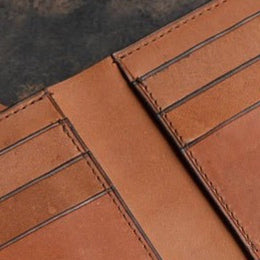
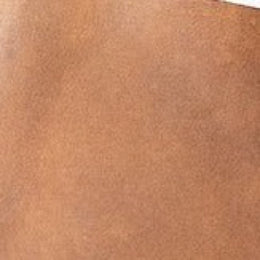
Full grain is the outermost layer, with nothing sanded off it. The fibres there are the tightest in the whole skin. Pores, healed scars and insect marks all stay, which is exactly why it ages instead of wearing out — it is the only grade that builds a real patina.
Top grain is that same outer layer, lightly corrected to even out the surface. Still strong, still good. A little more uniform, a little less alive.
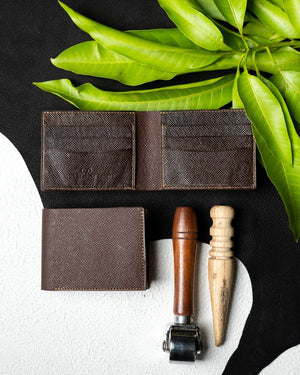
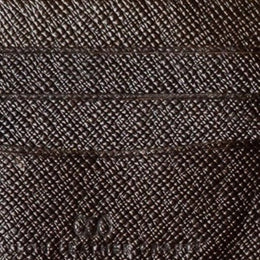
Split is what is left underneath once the top has been taken off. It has no grain of its own, so a pattern is embossed onto it and sealed under polymer. Look closely at one and the grain repeats — nothing in nature does that.
Most of what is sold as “genuine leather” is cut from that last layer. The phrase is not a grade and never was. It promises one thing only: that leather is in there somewhere.
Why good leather lasts
It gets better rather than worse. Synthetics start at their best and decline from there. Full grain starts firm and pale and darkens for years, taking the shape of whoever carries it.
It breathes. The hide keeps its natural porosity, which is why a leather strap against skin all day is comfortable in a way a coated material never is.
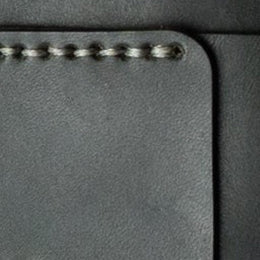
It can be repaired. A saddle-stitched seam can be opened and restitched. A glued, machine-run seam usually cannot.
No two pieces match. The marks a hide carried through its life are still on the surface, so every wallet cut from it is different.
How to tell what you are holding
Look at a cut edge. If the surface layer looks like a coating sitting on top of something spongy, you are holding a split. If the grain runs the whole way through, it is the real thing.
Then smell it, and press it with a thumb. Full grain creases and recovers. Coated split creases and stays creased.
What we use
Full grain and top grain. Nothing below that, ever. Every piece is cut and saddle-stitched by hand in Sri Lanka, and repaired for as long as you own it.
If you would like to go deeper into the individual hides — oil pull-up, full veg, semi veg, nubuck, embossed and wax-oiled — and what each one does in a pocket over ten years, that is set out in Understand the Leathers.